


A good gelato speaks for itself. The texture should be smooth, the flavours distinct, and every scoop should look as inviting as it tastes.
But once a customer orders a portion to take away, the gelateria faces a different challenge. The dessert has to survive a journey beyond the display cabinet, whether that means a short walk home, a drive across town or a delivery arranged for later.
This is where packaging becomes part of the product. A cup that softens, a lid that comes loose or condensation that makes the container slippery can turn a carefully prepared dessert into a disappointing experience.
For gelaterias, the details matter more than they might seem.
The Problem With a Cup That Looks Fine at First
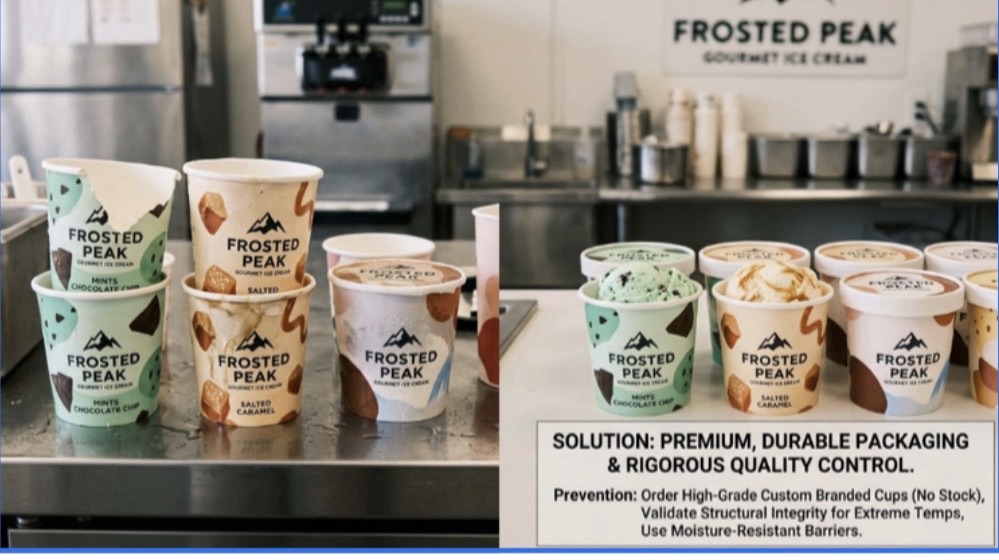
An emptyice cream cupcan look perfectly sturdy on the shelf. Fill it with frozen dessert, however, and its performance becomes much easier to judge.
Paper cups are particularly sensitive to moisture. Their rigidity depends not just on the thickness of the paperboard but also on the barrier layer, the quality of the seams and the time the dessert remains inside.
If moisture reaches the paperboard, the wall may gradually lose stiffness. The cup can become uncomfortable to hold or start to deform when handled.
A thicker cup is not necessarily the answer. A well-designed structure with an effective moisture barrier may perform better than a heavier cup with poorly controlled seams or an unsuitable coating.
For gelato businesses, the useful question is not simply how thick the cup feels when empty. It is whether the filled container stays stable throughout normal service.
Condensation Is Not the Same as a Leak
Anyone who has carried a cold drink outside on a warm day has probably seen water droplets form on the outside of the container.
The same thing happens with gelato cups.
When a cold cup meets warmer, humid air, moisture can condense on its surface. This is a normal physical process, not necessarily a sign that the container is leaking.
However, condensation can still cause practical problems. A wet paper wall may become less comfortable to hold, printed graphics may deteriorate, and a slippery exterior can make the cup harder to carry.
Actual leakage tends to require a different investigation. Moisture concentrated around the bottom seam or side joint, particularly when accompanied by traces of melted product, may indicate a weakness in the cup’s construction or barrier.
Knowing the difference helps staff avoid blaming the wrong part of the packaging.
A Lid Needs to Fit the Cup, Not Just the Label
Lids are another common source of trouble.
Two cups advertised with the same capacity do not necessarily have identical rim dimensions. A lid that fits one design may sit loosely on another, even when both products are described as suitable for the same serving size.
A loose lid creates an obvious risk during takeaway. The cup may be tilted inside a bag, squeezed between other items or carried in one hand while the customer walks.
Yet an excessively tight lid is not ideal either. If staff have to apply too much pressure to close it, the rim may deform. Customers may also struggle to remove it without squeezing the cup or spilling the contents.
The best fit strikes a balance: secure enough for normal handling, but practical for both staff and customers.
That is why cups and lids should be evaluated as a pair rather than chosen independently.
Takeaway Changes the Conditions

A gelato served immediately at the counter has a relatively straightforward journey. A takeaway portion faces more variables.
The cup may move around inside a shopping bag. It may be placed beside other desserts or carried in a vehicle. The lid can be knocked or pressed, and the dessert may begin to soften before it reaches its destination.
Toppings introduce another consideration. A portion filled above the rim leaves less space for the lid to close properly. Sauces or oversized scoops can interfere with the sealing area, increasing the chance of mess during transport.
The container should therefore suit the actual serving style. A small cup for a quick takeaway order may need different structural characteristics from a larger format intended for sharing or longer-distance transport.
The right packaging supports the way a gelateria serves its customers instead of forcing staff to change every part of the routine.
Why Paper Weight Is Only One Part of the Picture
When comparing paper cups, it is tempting to focus on GSM, the weight of the paperboard per square metre.
That figure is useful, but it does not tell the complete story.
Moisture resistance, coating consistency, bottom construction, side-seam quality and rim formation all influence the final result. A cup can feel rigid when dry and still become unreliable after prolonged contact with a frozen dessert and the surrounding condensation.
The same principle applies to choosing between paper and plastic. Neither material is automatically the best option for every gelato business. The decision depends on serving conditions, the required presentation, lid compatibility, material specifications and the applicable food-contact requirements.
The most sensible approach is to judge the finished container by how it performs with the actual product.
A Simple Test Before the Busy Season
Gelaterias do not need a complicated testing facility to identify many packaging problems.
A practical trial can begin with a few filled samples. Use the normal portion size, including toppings, and close each lid as staff would during service.
Leave the cups under realistic holding conditions. Check the walls, rim and bottom for softening or leakage. Move the containers as they would be carried in a takeaway bag, then inspect them again.
It is also worth asking staff to open and close several samples. A package that performs well in a controlled test but slows down service or requires awkward handling may not be the best everyday choice.
Testing more than one sample matters too. One cup with a perfect seal cannot establish whether the design performs consistently across a production batch.
Packaging Is Part of the Gelato Experience
Customers rarely visit a gelateria because they are interested in cup construction. They come for the flavours, the craftsmanship and the pleasure of eating good gelato.
That is precisely why packaging should work without drawing attention to itself.
A reliable cup keeps its shape. A properly matched lid stays in place. The dessert arrives looking much as it did when it left the counter, without unnecessary mess or handling problems.
For a gelateria, these may seem like small operational details. But they influence how customers experience the product beyond the shop itself.
Excellent gelato starts with ingredients and technique. When takeaway and delivery are part of the business, the packaging has a role to play as well. Getting that final detail right helps ensure that the quality created in the laboratory reaches the customer in the condition it deserves.
